Light isn’t magic. It is energy. Specifically, it is made of tiny, mass-less packets called photons. These particles carry momentum and energy, moving in straight lines until they hit something. To get them moving, you need to mess with an atom.
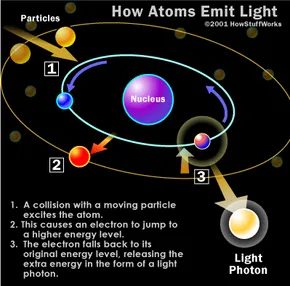
Atoms have a nucleus in the center. It’s positively charged. Swirling around it are electrons. They are negatively charged. The speed of an electron and its distance from that central nucleus determine its energy level. Electrons hang out in specific orbitals. Higher energy means the electron is further out.
When an atom absorbs energy—heat is a common example—an electron gets knocked up to a higher orbital. It’s unstable. It doesn’t stay there. Almost instantly, it snaps back to its original spot. That drop releases the excess energy. Sometimes, that release is a light photon.
The wavelength of that photon depends on the energy gap. Bigger drop, different wavelength. Different wavelength, different color. This is why different atoms emit different colors. It’s a direct link between the atomic structure and what you see.
Most light sources follow this rule. The difference is just how they excite the atoms. Take a standard incandescent light bulb. It uses heat. You run electricity through a filament, it gets hot, atoms vibrate, light comes out. A glow stick uses chemistry. Mix the chemicals, excite the atoms, get light.
Fluorescent lamps are different. They use a more complex method to get those electrons jumping. We will look at exactly how that system works in the next section.
The Physics of Glowing
Why does this matter for your home renovation? Because understanding the source helps you choose the right tool for the job. If you are swapping out fixtures or installing new lighting in a basement, knowing the difference between heat-based and gas-discharge lighting changes how you plan the wiring.
Incandescent bulbs waste most of their energy as heat. That is inefficient. Fluorescent tubes use a gas discharge process. They excite mercury vapor to produce ultraviolet light. Then, a phosphor coating converts that UV light into visible light. It’s a two-step process. It is more efficient, but the mechanism is more delicate.
You don’t need to understand quantum mechanics to change a bulb. But you should know that fluorescent lamps contain mercury. That means cleanup matters. If you break one, you can’t just sweep it up like glass. You need to ventilate the room. You need to handle the fragments carefully.
The color temperature you see on the box? That comes from the phosphor coating. The wavelength of the emitted light is controlled by the mix of chemicals in that powder. Cool white? Blue-leaning spectrum. Warm white? Redder spectrum. The physics is the same. The coating is different.
Choosing the Right Source
When you are standing in the aisle, staring at a wall of bulbs, the specs matter. Incandescent bulbs are simple. They last a short time. They produce a warm, consistent glow. But they burn out fast. Fluorescent tubes last longer. They use less power. But they can flicker. They can buzz.
If you are doing DIY work, safety is the first step. Turn off the breaker. Use a non-contact voltage tester. Don’t guess. Electricity doesn’t care if you know the physics of photons. It only cares about the circuit.
For general lighting, fluorescent lamps are still common in garages and utility rooms. They are bright. They spread light evenly. But for living spaces, many people are moving to LEDs. LEDs use electrolum