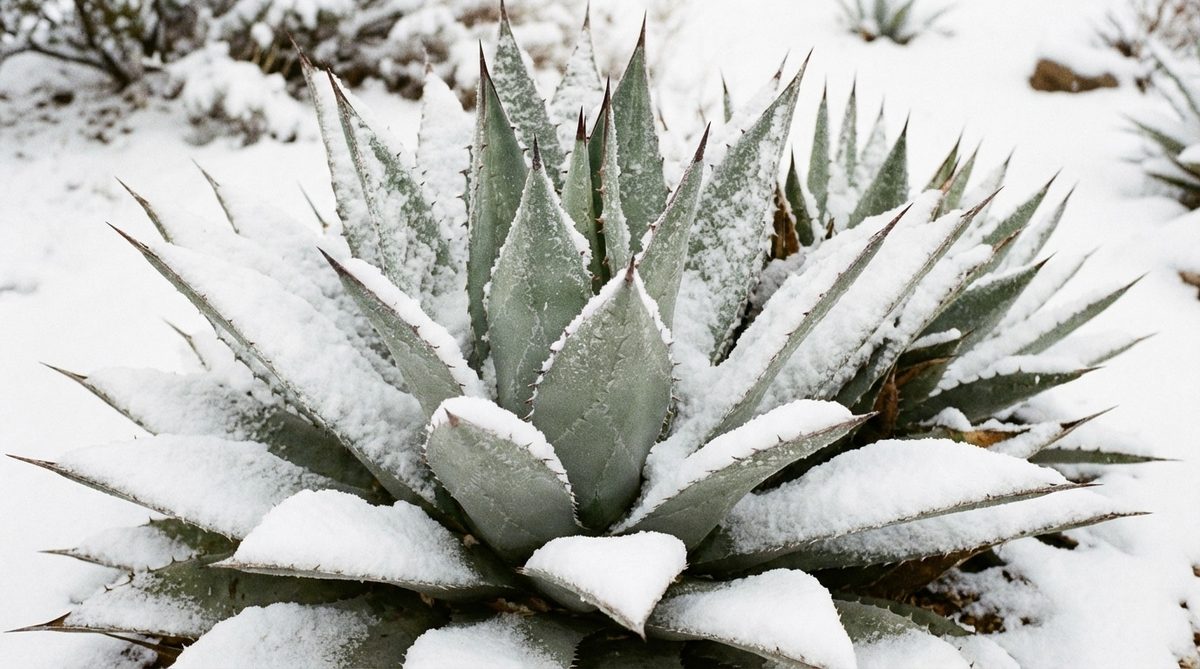
It looks majestic. Standing on a balcony or in the garden, the agave looks like an unbreakable sculpture. But then the snow hits in early January. Suddenly, those rigid, upward-pointing leaves sag. They look limp, watery, dead.
This is not a temporary reaction to the cold. It is a vital emergency. Many homeowners think winter sun will fix this. It won’t. Every hour matters. If you do nothing, the plant dies. Understanding what is happening inside the leaves is the first step to saving it.
Why snow kills agaves faster than dry cold
Garden centers sell agaves as nearly indestructible. They handle drought and heat well. That reputation is mostly true. But it hides a major weakness: humidity combined with freezing temperatures.
Snow is a trap. When it melts, it soaks the soil and the center of the plant with ice-cold water. Unlike autumn rain, which drains away, snow holds a wet, biting contact against the plant’s skin for hours. For a plant used to arid zones, this is a thermal and water shock. The thick outer layer that usually protects the leaves fails here. The cold wetness penetrates the tissue.
If you did not protect your agave before the snowfall, it is now a target for freeze damage.
How to spot internal rot vs. temporary stress
Look closely at the leaves. If they are soft, translucent, or look glassy, the cells have burst. The water inside the tissue froze, expanded, and tore the cell walls apart. When the temperature rises slightly, the structure collapses.
The real danger is what comes next: rot.
Soft leaves in January are a sign of putrefaction. This biological decay does not stay in the outer leaves. It moves quickly toward the meristem, the vital heart of the plant. Once the heart is touched, the agave is finished.
Treat those hanging leaves as an internal hemorrhage. You must stop the bleeding now.
Where to move your agave to stop the damage
Do nothing is the worst option.
If your agave is in a pot, move it indoors immediately. The goal is to stop the freeze exposure and stop the moisture intake.
Place it in a specific location:
– A bright room that is not heated. Aim for temperatures between 5°C and 10°C.
– A garage with a window.
– An unheated porch or veranda that is above freezing.
The spot must be dry and airy.
If the agave is planted in the ground and you cannot move it, the task is harder. Install a temporary protection over it. Use a cloche or an improvised roof. The goal is to keep more precipitation off the plant while allowing air to circulate so the tissue can dry.
Do not water the plant. Not a drop. Until the weather warms up permanently, water is poison.
Which tools you need to cut away the dead tissue
Once the plant is safe from the cold, you must cut. This is the painful part for the gardener. But it is the only way to save the heart.
Keeping the soft leaves hoping they will heal is a mistake. They are infection centers. You need a sharp tool and courage.
Here is the procedure:
- Take a sharp knife or pruning shears.
- Disinfect the tool with 90-degree alcohol. This stops you from spreading pathogens to healthy tissue.
- Cut the affected leaves. Do not cut at the soft edge. Cut well below the soft part, into the firm, healthy tissue.
- If the rot is close to the trunk, dig slightly to remove any brown or gelatinous material.
- Apply cinnamon powder or crushed charcoal to the cuts. These natural products act as fungicides and help the wound heal.
This drastic cut looks like mutilation. But it redirects the plant’s energy. Instead of wasting resources on dying tissue, the agave focuses on keeping its heart alive.
How to know if your agave survived the freeze
Patience is the only tool that matters here. The plant looks dead. It feels dead. It is almost certainly still alive, provided you stop touching it.
The weeks following the rescue are a total dry period. No water. Not a drop. The soil bed must crack and dry out completely. Any moisture left in the root zone will finish the job the cold started. Rot moves fast in wet, cold soil.
Watch the cut surfaces closely. This is the diagnostic phase.
- Bad sign: Black spots appear on the remaining tissue. The infection is still active.
- Good sign: The cut edges dry out and form a beige or whitish scab. This is a callus. It means the plant has sealed itself off from the rot.
If you see that scab, you have bought time.
When to expect new growth
Spring is the deadline. Specifically, when nighttime temperatures stay above 10°C (50°F) consistently.
Until then, the plant stays dormant. It will look stagnant. Do not fertilize. Do not trim. Do not water.
The first real proof of life is a new central leaf. It will be tender green and point upward. That single sprout confirms the heart of the plant was preserved. The vascular system is still working.
Why this survival strategy works
Agaves are resilient, but they are not indestructible. They need a specific window to bounce back from freeze damage.
Reactivity matters more than perfection. You do not need to save every leaf. You need to save the meristem. If you act at the first sign of blackening, you often save the crown.
Check your winter garden. Even the toughest succulents need a hand. The difference between a dead plant and a recovering one is usually just one dry, quiet winter and a spring leaf.