The world runs on steel fasteners. But if you’ve ever stood in the hardware aisle, staring at two nearly identical pieces of threaded metal, you know the “bolt vs. screw” debate isn’t just academic. It’s practical. And picking the wrong one can ruin a project faster than you can say “stripped head.”
Both are externally threaded fasteners. That’s the only similarity worth noting. Beyond that, their mechanics, applications, and required hardware diverge completely. Confusing them leads to weak joints or broken tools.
Let’s break down exactly how to tell them apart so your next build holds tight.
Bolts 101: The Nut-and-Wrench System
Bolts are designed to be paired with nuts. They don’t bite into material on their own. They clamp things together using a nut on the opposite side, often with a washer to distribute pressure.
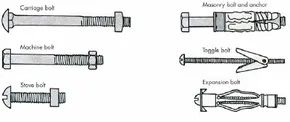
The core types you need to know are carriage bolts, stove bolts, and machine bolts. For hollow walls, you’ll use toggle bolts or expansion bolts.
Carriage Bolts
These are furniture favorites. They feature a round head with a square collar underneath. The square part twists into pre-drilled wood, preventing the bolt from spinning while you tighten the nut. They are coarse-threaded and range from 3/16 to 3/4 inch in diameter. Lengths go up to 10 inches.
Stove Bolts
Don’t let the name fool you. They aren’t just for old-fashioned stoves. They are versatile, fastening jobs everywhere. Look for a slotted head (flat, oval, or round) that accepts a screwdriver. However, they are usually tightened with a nut and wrench. Most are fully threaded, though larger sizes may have a smooth shank near the head. Diameters range from 5/32 to 1/2 inch. Lengths cap at 6 inches.
Machine Bolts
These demand torque. They have square or hexagonal heads and require wrenches and matching nuts (square or hex). They come in fine or coarse threads. Sizes are substantial, ranging from 1/4 inch to 2 inches in diameter and up to 30 inches long. Note that bolt size is listed as diameter by threads per inch (e.g., 1/4 x 20).
Hollow Wall Solutions
When fastening lightweight objects like picture frames to drywall, you can’t use standard bolts.
* Toggle bolts: Spring-loaded wings open inside the wall cavity.
* Expansion bolts: Inserted into a jacket that expands as you tighten.
Diameters run from 1/8 to 1/2 inch. Lengths reach 8 inches for walls up to 1-3/4 inches thick.
Screws 101: The Self-Tapping Powerhouse
Screws work differently. They use rotational motion and torque to create their own grip. They don’t need a nut. Instead, they bite into a material or a pre-tapped hole with internal threads.
This makes them permanent. Once driven, they stay.
Sheet Metal Screws
These have threading all the way up the shank. Fully threaded. This design provides maximum grip for thin, flexible materials like sheet metal.
Machine Screws
A catch-all term. These usually have blunt-ended tips and are fully threaded to the head. They are designed to screw into tapped holes in metal or plastic.
Wood Screws
The DIY staple. Sharp-pointed. Most feature a smooth, unthreaded shank near the head. This design allows the screw to pull two pieces of wood tightly together as you tighten it. The threads only engage the bottom piece.
How to Choose the Right Fastener
The distinction boils down to mechanics. Do you need a clamp? Use a bolt with a nut. Do you need to bite into material? Use a screw.
If you are building furniture where pieces are accessible on both sides, a carriage bolt offers a clean finish. If you are attaching brackets to brick, a masonry bolt is your only option. If you are assembling cabinets where you can’t reach the back, a screw is likely your best bet.
Still stuck? Describe your project to a professional at a local hardware store. Show them the materials. They’ll point you to the right aisle.
Beyond the Debate
Understanding fasteners is just the start of a successful build. You also need the right tools to drive them. A wrench is useless on a screw head. A screwdriver will strip a hex bolt.
Knowing which wrench fits which nut is just as important as knowing which fastener fits which hole. Master the hardware, and the building becomes simple. Ignore it, and you’ll be fighting the material instead of working with it.
Which fastener have you stripped this week?